
 Europe destination
Ireland
The EU's English-speaking tech hub, with a two-year stay-back for master's graduates.
Overview
Ireland occupies a useful niche that bigger destinations miss. It is the only English-speaking country in the European Union, which makes it the natural European base for American multinationals, and their European headquarters cluster around Dublin in remarkable density. Google, Apple, Meta, Pfizer and dozens more employ thousands there. For Indian graduates, that concentration means internships and graduate roles within a small, navigable job market where a well-targeted application actually gets read.
The immigration settings are pragmatic. Master's graduates get a two-year Stamp 1G permission to find skilled work, and the Critical Skills Employment Permit covers the occupations Ireland needs most, from software development to nursing, with a direct path to long-term residence. Undergraduate programs are typically four years, and one-year taught master's degrees keep total costs below the UK for a comparable qualification. English is the language of everything, which removes the integration hurdle that Germany or the Netherlands impose.
Scale is the honest trade-off. Ireland's population is just over five million, so the absolute number of roles is smaller than in London or Toronto, and Dublin rents are high. But for students and professionals in tech, pharma, finance and healthcare, the ratio of opportunity to competition is genuinely favourable, and the Indian community in Dublin and Cork is active and growing.
2 years
Stamp 1G stay-back after an Irish master's degree
1,000+
Multinationals with EMEA headquarters in Ireland (approx.)
EUR 10,000
Yearly living-cost proof for a student visa (approx.)
Opportunities
Where Ireland makes sense for Indians
One-year master's with two-year stay-back
Taught master's programs finish in twelve months and graduates get two years on Stamp 1G to secure skilled employment, a strong return on a single year of tuition.
Critical Skills permits in tech and pharma
Software engineers, data professionals, biotech specialists and nurses hired into listed occupations get permits with reduced fees and a fast route to Stamp 4 long-term residence.
Multinational graduate programs
Dublin's concentration of EMEA headquarters runs structured graduate intakes each year, and Irish work experience is valued across the EU afterwards.
Healthcare and nursing roles
Ireland recruits nurses and care professionals actively, with registration through the NMBI and employer support for relocation in many cases.
Visa routes
Visa categories we handle for Ireland
Student Visa (Stamp 2)
For full-time study at an approved Irish institution. Requires an offer letter, proof of funds of around EUR 10,000 per year of study plus tuition, and private medical insurance.
Third Level Graduate Programme (Stamp 1G)
Allows graduates of Irish degrees to stay and work for up to twelve months after a bachelor's or two years after a master's or PhD, with no employer sponsorship needed.
Critical Skills Employment Permit
For highly skilled roles on the Critical Skills Occupations List or any role paying above the higher salary threshold. Leads to Stamp 4 residence after two years.
General Employment Permit
For occupations not on the ineligible list, with a labour market needs test in most cases and a lower salary threshold than the Critical Skills route.
Stamp 4 Long-Term Residence
Permission to live and work in Ireland without an employment permit, typically available after two years on a Critical Skills permit or five years on other permissions.
Short Stay Visitor Visa
For tourism and family visits up to 90 days. Indian nationals need a visa in advance; strong ties to India and clear travel plans support approval.
Study in Ireland
Universities, costs and SOP guidance
Real universities with official links, rough tuition figures marked approx., and statement-of-purpose advice shaped for Ireland.
Universities to know
Popular courses
Rough study costs
Bachelor’s · per year
EUR 10,000 – 25,000 per year (approx.)
Master’s · per year
EUR 12,000 – 28,000 per year (approx.)
The student visa requires proof of around EUR 10,000 per year for living costs on top of tuition; Dublin rents are the highest in the country (approx.).
Essay & SOP guidance
- Irish visa officers weigh genuine intent heavily. Your study plan statement must explain why Ireland and why this course — not just why studying abroad.
- Connect the course to Ireland's job market: reference the multinational presence in Dublin or the Critical Skills Occupations List where relevant to your field.
- Show a coherent academic or career path. A sudden switch of fields without explanation raises questions; justify pivots with work experience or clear reasoning.
- Be transparent about funds: the EUR 10,000-per-year living cost requirement plus tuition must be traceable to savings, loans or sponsors.
- Write in clear, professional English and keep it to one or two pages. Irish institutions and officers prefer direct, well-organised writing.
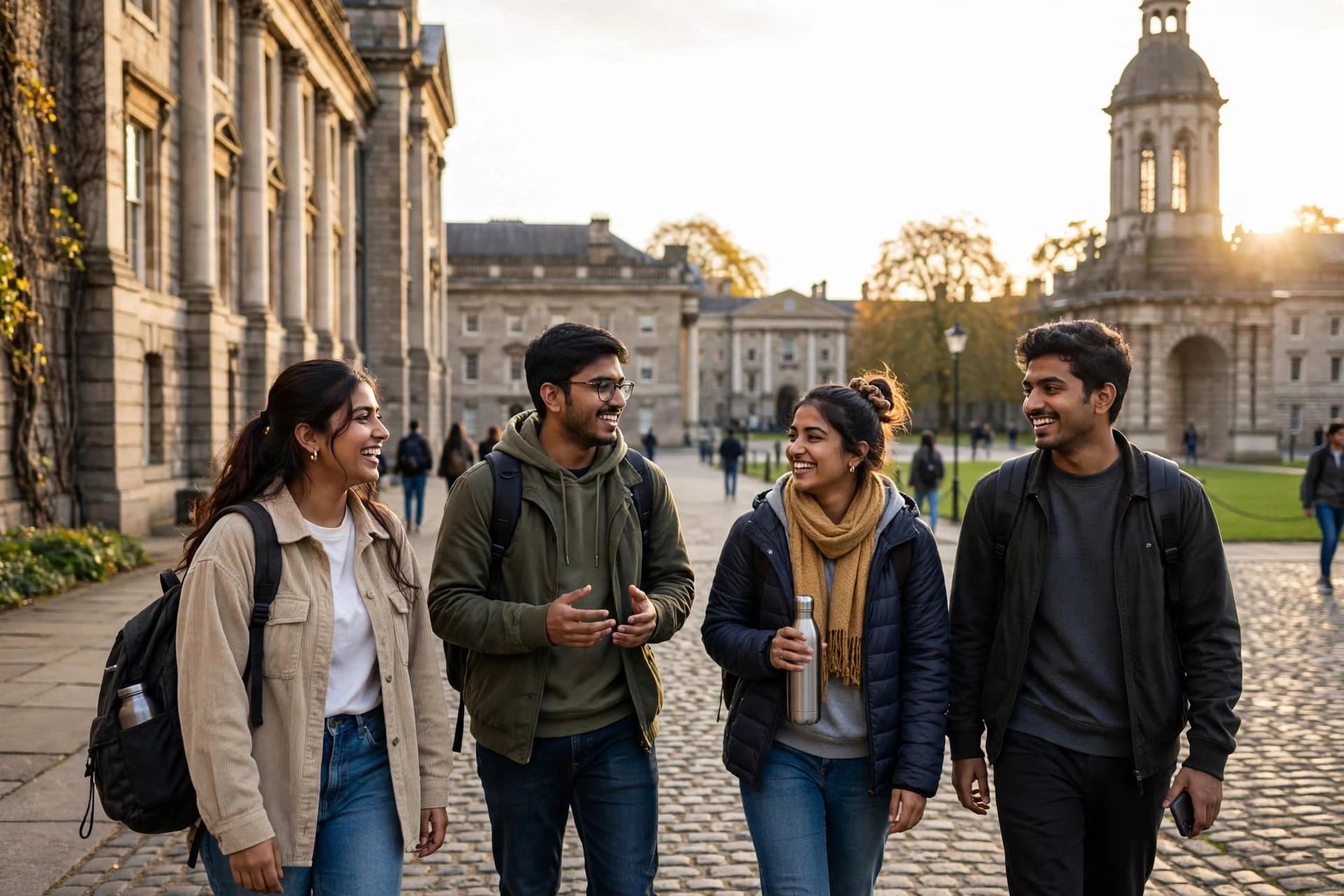
Life in Ireland
Beyond the visa: settling in
A visa gets you to Ireland. Our pre-departure briefings cover the rest: the practical groundwork of your first month, explained before you board.
- Housing: what to arrange before you fly and what to sort after landing
- Money: forex, international cards and opening a local bank account
- Health cover and insurance requirements for your visa type
- Local essentials: transport, connectivity and emergency contacts
Eligibility
What you generally need
- Funds: usually around EUR 10,000 per year of study for living costs plus full tuition, shown in a student bank account or through a loan.
- English: IELTS usually around 6.0 to 6.5 overall for degree programs; some universities accept PTE or Duolingo equivalents.
- Critical Skills salary: the role must meet the current threshold for the occupation list or the higher general threshold; verify the latest figures before relying on an offer.
- Qualifications: relevant degree for the role, with NMBI registration for nurses and CORU registration for some health and social care professions.
- Health insurance: private medical insurance is mandatory for students and must cover the full stay.
- Immigration history: a clean record matters; previous refusals in Ireland, the UK or Schengen states must be declared honestly.
Process
How we take your file forward
Course and career alignment
We shortlist Irish universities and programs against your budget and the occupations Ireland actually hires for, so the degree connects to the Stamp 1G job market afterwards.
Applications and documentation
University applications, offer acceptance, fee payment scheduling and the fund statements are handled in sequence, timed to the September or January intake.
Visa lodgement
The online application with biometrics at the VFS centre, including the study plan statement that explains why Ireland and why this course. Irish visa officers weigh genuine intent heavily.
Work permit cases
For Critical Skills and General permits, we work with the employer's details to confirm the occupation qualifies, the salary meets the threshold and the contract terms are complete before filing.
Decision and travel
Decisions typically take several weeks. We track the application, respond to any additional document requests quickly, and plan travel only after the visa is in hand. The final decision always belongs to the Irish immigration authorities.
Arrival and GNIB registration
Registering with immigration on arrival, opening a bank account, PPS number for employment, and understanding the work-hour limits on Stamp 2.
FAQ
Ireland, answered
Tuition for international taught master's programs usually ranges from EUR 12,000 to EUR 25,000. With living costs of around EUR 10,000 to 14,000 per year, the total for the year is roughly Rs. 22 to Rs. 38 lakh, generally less than a comparable UK degree.
Yes, Stamp 2 holders can work up to 20 hours per week during term and 40 hours during holidays in December, January, June, July, August and September. Dublin's service and retail sectors hire students regularly.
It is the immigration permission graduates switch to after their studies, allowing full-time work for any employer without sponsorship: one year after a level 8 degree, two years after a level 9 master's or level 10 PhD.
Join-family visas exist for partners and children of work permit holders and some students, with financial requirements per family member. Processing takes several months, so early application is wise.
It depends on priorities. Ireland offers lower tuition, a two-year stay-back and an English-speaking EU base with heavy multinational presence. The UK has more universities and a larger job market. We compare both against your field before recommending.

Free initial consultation
Ireland on your mind? Let's check your eligibility.
A free consultation reviews your profile against Ireland's actual requirements and tells you honestly where you stand. No obligation, no sales pitch.