
 Europe destination
Netherlands
English-friendly Europe with a one-year job search visa and one of the continent's best work-life balances.
Overview
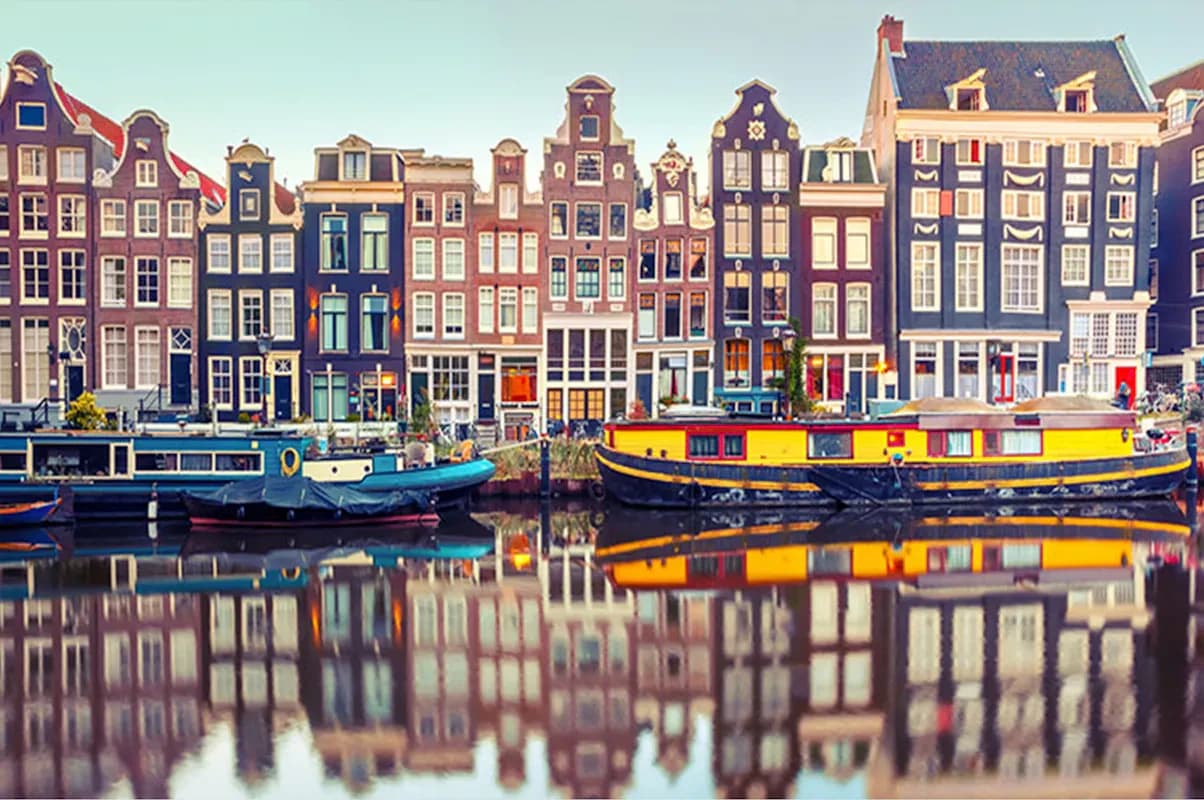
The Netherlands is the quiet overachiever of European migration. Nearly everyone speaks English, universities offer the largest selection of English-taught programs in continental Europe, and Amsterdam's startup and tech scene punches far above the country's size. For Indian students and professionals who want Europe without a language barrier on day one, it is arguably the most practical choice on the continent.
Immigration policy here is employer-friendly and unusually clear. The Highly Skilled Migrant scheme lets recognised sponsors hire foreign professionals with a salary threshold that is notably lower for recent graduates, and the Orientation Year permit gives graduates of Dutch universities, and top global universities, a full year to find skilled work without a sponsor. Once employed, the path to long-term EU residence is well marked. The 30% tax ruling, which exempts a portion of salary from tax for qualifying migrants, makes Dutch offers more competitive than they first appear.
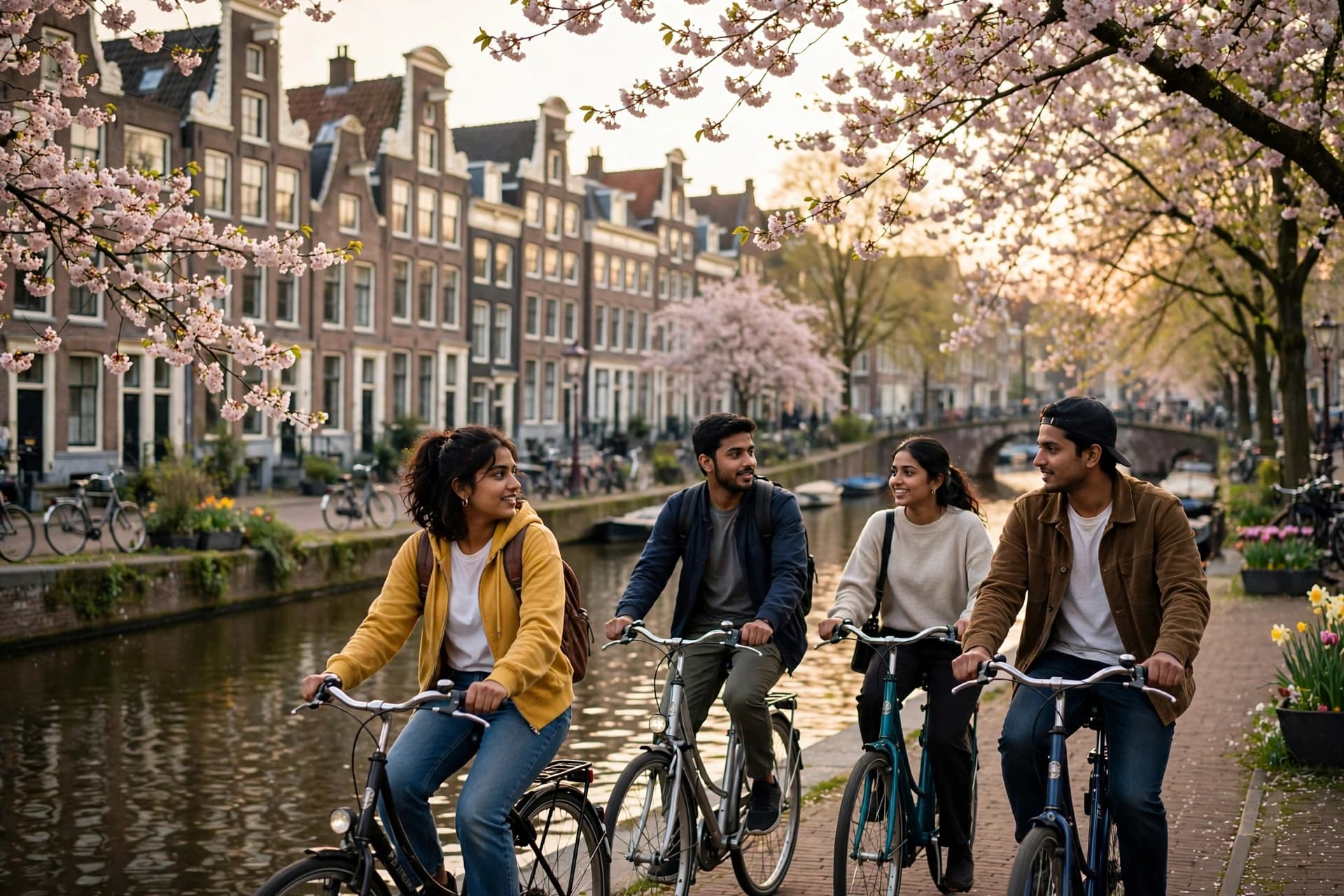
Daily life is the selling point that statistics miss. Cycling infrastructure, compact cities, direct communication at work, and a culture that treats a 40-hour week as a ceiling rather than a floor. Housing is the genuine pain point: Amsterdam, Utrecht and Eindhoven have real shortages, and newcomers should budget time and money for the search. We say this upfront because it is the one part of the Dutch dream that requires patience.
1 year
Orientation Year job-search permit for eligible graduates
2,000+
English-taught study programs, the most in continental Europe (approx.)
30%
Tax-free salary portion under the 30% ruling for qualifying migrants
Opportunities
Where Netherlands makes sense for Indians
English-taught bachelor's and master's degrees
Research universities and universities of applied sciences offer hundreds of English-taught programs, with tuition lower than the UK and strong graduate employment rates.
Highly Skilled Migrant tech roles
Amsterdam and Eindhoven sponsors hire software engineers, data professionals and designers, with a reduced salary threshold for graduates under 30.
Orientation Year job search
Graduates get twelve months to find skilled work without sponsorship, and the permit also covers graduates of top-ranked universities worldwide.
Logistics, agri-tech and finance careers
Rotterdam's port, the food and flower industries and Amsterdam's financial sector all employ international professionals in English-speaking roles.
Visa routes
Visa categories we handle for Netherlands
Highly Skilled Migrant (Kennismigrant)
Residence for professionals hired by IND-recognised sponsors meeting the salary threshold, with a lower threshold for those under 30 and fast processing.
Orientation Year (Zoekjaar)
A one-year residence permit for graduates of Dutch institutions or top global universities to search for skilled work or start a business, with no sponsor required.
Student Visa (MVV and Residence Permit)
Indian students need an MVV entry visa plus a residence permit, arranged through the university as the recognised sponsor, with proof of funds for living costs.
EU Blue Card (Netherlands)
The EU-wide permit for highly qualified workers with a recognised degree and a qualifying salary, offering mobility across EU states after eighteen months.
Partner and Family Reunification
Partners and children of highly skilled migrants and students can join, with the sponsor meeting income requirements; partners of highly skilled migrants may work freely.
Schengen Visitor Visa
For tourism and short business trips up to 90 days, applied through the Dutch mission when the Netherlands is the main destination.
Study in Netherlands
Universities, costs and SOP guidance
Real universities with official links, rough tuition figures marked approx., and statement-of-purpose advice shaped for Netherlands.
Universities to know
Popular courses
Rough study costs
Bachelor’s · per year
EUR 8,000 – 16,000 per year in non-EU institutional fees, varying by program (approx.)
Master’s · per year
EUR 12,000 – 22,000 per year in non-EU institutional fees, varying by program (approx.)
Expect living costs of roughly EUR 1,000 – 1,400 per month (approx.); graduates can use the one-year orientation (zoekjaar) visa to find skilled work.
Essay & SOP guidance
- Dutch motivation letters are short and specific — explain why this exact program, which courses or tracks interest you, and how it connects to your background. Generic praise of the Netherlands is ignored.
- Numerus fixus programs (medicine, psychology, some business degrees) run selection procedures with extra essays and tests; prepare months ahead, not weeks.
- Be direct about grades and skills. Dutch admissions culture is egalitarian and factual — clear evidence beats lofty claims.
- Apply through Studielink before program deadlines, which are often earlier than you expect (January for many selective programs).
- Mention post-study plans honestly. Universities and visa officers both respond well to applicants who understand the orientation-year route and the Dutch job market.
Life in Netherlands
Beyond the visa: settling in
A visa gets you to Netherlands. Our pre-departure briefings cover the rest: the practical groundwork of your first month, explained before you board.
- Housing: what to arrange before you fly and what to sort after landing
- Money: forex, international cards and opening a local bank account
- Health cover and insurance requirements for your visa type
- Local essentials: transport, connectivity and emergency contacts
Eligibility
What you generally need
- Highly Skilled Migrant salary: must meet the annual threshold, lower for under-30s; the figures are indexed yearly, so current numbers should be confirmed.
- Recognised sponsor: the employer must be registered with the IND as a recognised sponsor, which we verify before you accept an offer.
- Student funds: usually around EUR 13,000 to 15,000 per year for living costs plus tuition, demonstrated through the university's financial process.
- English: IELTS usually around 6.0 to 7.0 for university admission; the work routes do not have a formal language test.
- Orientation Year: available within three years of graduating from an eligible Dutch or top-ranked foreign university.
- Health insurance and TB test: Dutch health insurance is mandatory from the start of residence, and Indian nationals need a TB test after arrival.
Process
How we take your file forward
Route selection
Study, Highly Skilled Migrant or Orientation Year: we match your degree, age and budget to the route with the cleanest path, including whether the 30% ruling is likely to apply to your salary.
University or employer shortlisting
For students, English-taught programs at research and applied-science universities with realistic admission odds. For professionals, targeting IND-recognised sponsors in your sector.
Sponsor filing and MVV
The university or employer files with the IND as your sponsor; once approved, you collect the MVV entry visa from the Dutch mission in India. We prepare your document set for both stages.
Housing strategy
We start the housing search early with realistic expectations and verified platforms, because this is where Dutch moves most often stall. Never transfer deposits for unseen rooms without verification.
Arrival formalities
Municipal registration, BSN number, bank account, health insurance and the IND residence card appointment. The IND makes all final decisions on permits; our work is making the file complete and correctly sequenced.
Integration and career support
Orientation Year graduates get job-search guidance tuned to the Dutch market, where direct applications and networking carry more weight than portals alone.
FAQ
Netherlands, answered
Not for admission or most skilled jobs, since English suffices in universities and international companies. For long-term settlement, civic integration exams require basic Dutch, and daily life outside Amsterdam is easier with it, so we recommend starting early.
Tuition for non-EU students usually runs EUR 8,000 to EUR 20,000 per year depending on the program and institution. With living costs of roughly EUR 13,000 to 15,000 annually, budget around Rs. 20 to Rs. 32 lakh per year.
A tax facility letting qualifying highly skilled migrants receive 30% of their salary tax-free for up to five years. The employer applies for it, and it significantly raises net pay, though eligibility rules have been tightened and should be checked.
It is the hardest part of moving. Amsterdam and Utrecht have genuine shortages and high rents. Starting the search months early, considering nearby cities, and using verified platforms makes it manageable, but it needs active effort.
Partners of Highly Skilled Migrants receive residence with full labour market access, meaning they can work for any employer without a separate permit. Partners of students have more limited rights.


Free initial consultation
Netherlands on your mind? Let's check your eligibility.
A free consultation reviews your profile against Netherlands's actual requirements and tells you honestly where you stand. No obligation, no sales pitch.