 Asia destination
South Korea
World-class tech universities, the GKS full scholarship, and Asia's most dynamic graduate job market.
Overview
South Korea pairs elite universities with some of the world's most generous government scholarships. Seoul National University, KAIST and POSTECH rank among Asia's best for engineering and technology, while tuition at national universities stays far below US and UK levels. The Global Korea Scholarship (GKS) covers full tuition, airfare and a monthly stipend for selected international students — one of the few fully funded routes to a top-ranked global university.
The D-2 student visa process is straightforward once a university issues its Certificate of Admission: financial proof of roughly USD 20,000 for Seoul-based study (less elsewhere) plus standard documentation, and the visa typically follows without an interview. Many undergraduates need TOPIK level 3–4 in Korean, though English-taught programs are growing fast, especially at graduate level. Students may work part-time after six months with university permission, subject to Korean proficiency requirements.
After graduation, the D-10 job-seeker visa gives graduates a points-based route to stay and find work — points for age, Korean ability, degree level and salary offers. Korea's tech, manufacturing and research sectors hire skilled foreigners, but the honest caveat is language: roles at Korean companies usually expect strong Korean (TOPIK 4+), while multinational and research roles can run in English. We plan language study alongside the degree from day one.
KRW 1,000,000+
Monthly GKS undergraduate stipend (approx.)
USD 20,000
Typical financial proof required for Seoul universities (approx.)
25 hrs/week
Maximum part-time work during term for D-2 holders (approx.)
Opportunities
Where South Korea makes sense for Indians
GKS full government scholarship
The Global Korea Scholarship funds tuition, return airfare, a monthly stipend and a year of Korean language training for selected undergraduates and postgraduates.
Elite STEM universities at moderate cost
KAIST, POSTECH and Seoul National University compete with the world's best in engineering and science, with national-university tuition a fraction of Western equivalents.
D-10 points-based job-seeker visa
Graduates can remain in Korea on the D-10 visa while hunting for skilled work, with points awarded for Korean proficiency, qualifications and salary level.
Tech and research career pathways
Semiconductors, batteries, AI and shipbuilding giants — plus growing English-friendly research institutes — recruit international STEM graduates.
Visa routes
Visa categories we handle for South Korea
D-2 Student Visa
For full-time degree study at a Korean university. Requires the Certificate of Admission, financial proof and standard documentation; issued after the university registers you.
D-4 General Training Visa
For Korean language programs at university language institutes — the common route for students building TOPIK levels before degree entry.
D-10 Job Seeker Visa
Points-based residence for graduates seeking skilled work in Korea. Points cover age, education, Korean proficiency and income; valid for an extended job-hunting period.
E-7 Specially Designated Activities
The main skilled work visa once you have a job offer in a qualifying professional, technical or managerial role.
F-5 Permanent Residence
Long-term settlement route for those who build years of legal residence, stable income and Korean proficiency in Korea.
Study in South Korea
Universities, costs and SOP guidance
Real universities with official links, rough tuition figures marked approx., and statement-of-purpose advice shaped for South Korea.
Universities to know
Popular courses
Rough study costs
Bachelor’s · per year
USD 4,000 – 7,000 per year at national universities; USD 8,000 – 12,000 per year at private universities (approx.)
Master’s · per year
USD 5,000 – 9,000 per year at national universities; USD 9,000 – 14,000 per year at private universities (approx.)
GKS scholars pay no tuition and receive a monthly stipend; expect Seoul living costs of roughly USD 800 – 1,200 per month (approx.).
Essay & SOP guidance
- GKS applications include a personal statement and study plan — write them as one story: why Korea, why this field, and how you will contribute to Korea-India exchange.
- Korean universities value clear academic purpose. Name the department, relevant coursework and the professors or labs whose work interests you.
- If applying without TOPIK, state a concrete Korean-learning plan. Commitment to the language signals seriousness to both universities and scholarship panels.
- Keep achievements factual and verifiable. Korean admissions culture respects modesty backed by evidence over sweeping self-praise.
- For the language-school route, your statement should explain the longer plan — language study leading to a specific degree — so the visa officer sees a coherent pathway.
Life in South Korea
Beyond the visa: settling in
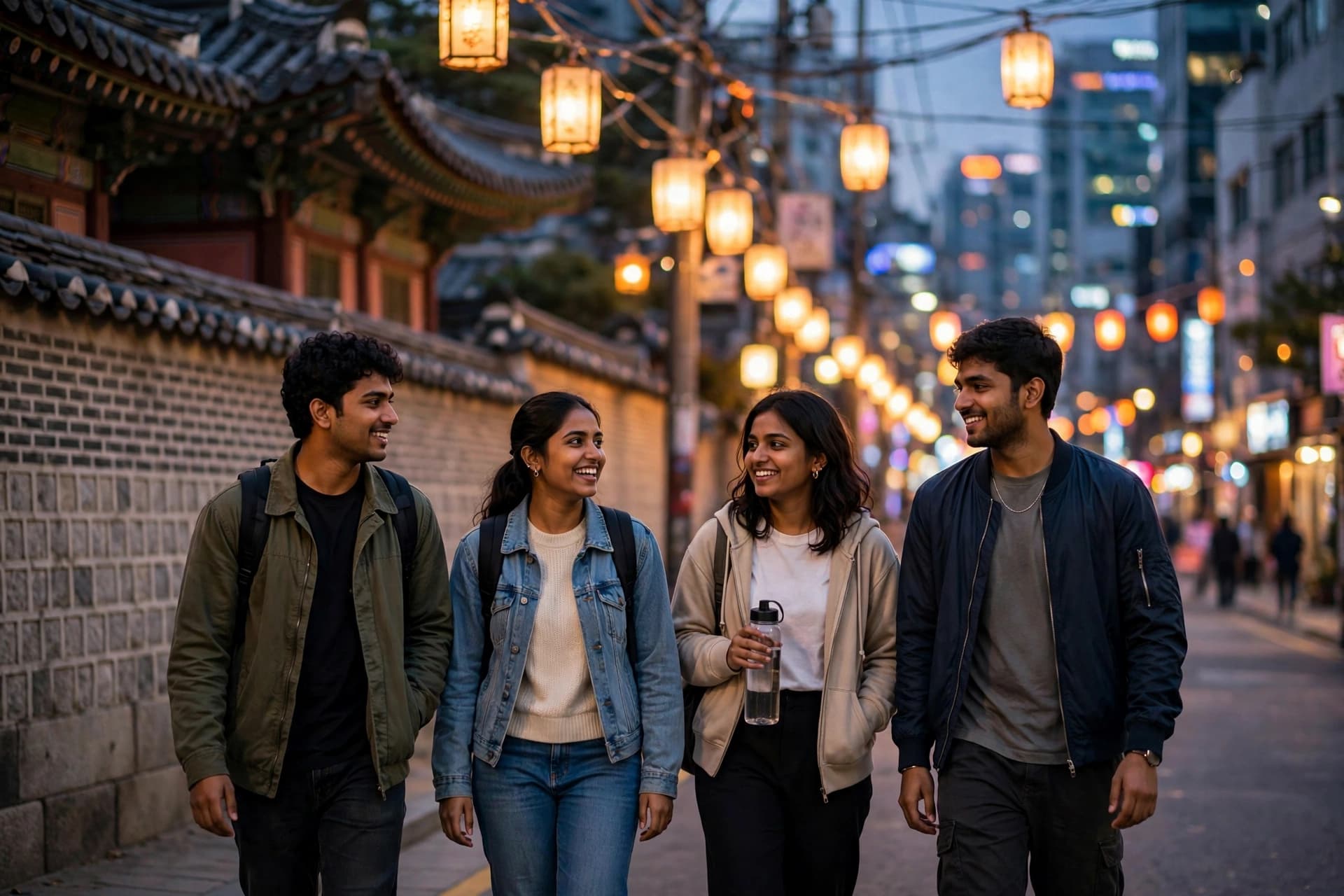
A visa gets you to South Korea. Our pre-departure briefings cover the rest: the practical groundwork of your first month, explained before you board.
- Housing: what to arrange before you fly and what to sort after landing
- Money: forex, international cards and opening a local bank account
- Health cover and insurance requirements for your visa type
- Local essentials: transport, connectivity and emergency contacts
Eligibility
What you generally need
- 12 years of schooling for bachelor's entry; a recognised bachelor's degree for master's programs.
- TOPIK level 3–4 for most Korean-taught undergraduate programs; IELTS 6.0+ or equivalent for English-taught tracks (requirements vary by university).
- Financial proof of roughly USD 20,000 for Seoul universities or USD 18,000 elsewhere, held in the student's or sponsor's account (approx.).
- GKS applicants need strong academics, and must apply through either the embassy track or the university track — not both in the same year.
- Clean immigration and criminal record, plus medical fitness suitable for long-term residence.
- A clear study plan connecting the chosen program to realistic career goals in Korea or back home.
Process
How we take your file forward
Route and university shortlisting
We decide between the GKS scholarship track, direct admission, and the language-school pathway, then shortlist universities against your grades, budget and TOPIK/IELTS level.
Documents and apostille
Academic transcripts, graduation certificates, financial statements and family-relation documents are prepared, translated and apostilled as each university requires.
Application and admission
We file applications in the correct intake window (March or September), track interviews or essays where required, and secure the Certificate of Admission.
D-2 visa issuance
With the Certificate of Admission and financial proof, we lodge the D-2 application at the Korean mission — typically processed within weeks.
Arrival and alien registration
Within 90 days of arrival you register at the local immigration office for your residence card, complete university orientation and arrange health insurance.
FAQ
South Korea, answered
The Global Korea Scholarship generally covers full tuition, return airfare, a monthly living stipend and one year of Korean language training before the degree begins. It is competitive and merit-based — we assess your chances honestly before you invest in the application.
Not for English-taught programs or the GKS track (which includes a language year). But Korean-taught undergraduate programs usually require TOPIK 3–4, and strong Korean dramatically improves your job prospects after graduation.
National universities charge roughly USD 4,000 – 7,000 per year for undergraduates; private universities roughly USD 8,000 – 12,000 (approx.). Seoul living costs run about USD 800 – 1,200 per month (approx.).
Yes — after six months of enrolment and with university permission, D-2 holders can work up to 20–25 hours per week during term, with Korean proficiency requirements attached.
Graduates can switch to the D-10 job-seeker visa, a points-based permit that lets you remain in Korea while finding skilled work, then convert to an E-7 work visa with a qualifying job offer.
Yes for STEM, business and Korean-studies students with strong academics — especially via GKS. The main commitment is language: students who reach TOPIK 4+ open far more doors in the Korean job market.
Free initial consultation
South Korea on your mind? Let's check your eligibility.
A free consultation reviews your profile against South Korea's actual requirements and tells you honestly where you stand. No obligation, no sales pitch.